
Artificial Intelligence
Americans are just beginning to grapple with the potential impacts of artificial intelligence on their lives. Political leaders, academics, journalists, pundits, and even those in related industries are struggling to keep up with the consequences ahead, good and bad. Debates about data centers, energy use, and worker protections have dominated the public conversation. At the same time, AI itself is broadly viewed as a useful technology with the potential to improve products, services, and economic growth. Voters’ biggest concerns are not about the technology itself, but about whether powerful corporations and their allies in government will use it in ways that benefit themselves at the expense of everyone else.
At a moment when concerns about affordability and corporate profit-seeking continue to shape the political landscape, we must focus attention on how corporations are deploying AI to reduce their workforce, maximize profits, and raise prices on consumers. New survey and qualitative research conducted by Global Strategy Group on behalf of American Horizon suggests that policies and messages centered on corporate accountability in the age of AI have the potential to breakthrough.
One clear first step is preventing health insurance companies from using AI to deny patient claims, including on Medicare. The research finds voters are deeply troubled by having a machine, not their doctor, decide whether they get access to health care, and conclude this will all lead to higher costs and even more denials. When Americans are informed this is already happening in Medicare, they are deeply troubled both for current beneficiaries and their future access to care.
Don’t just universally blame AI. Focus on those who are using AI to drive down their own costs while raising prices on consumers, deny care to patients while they bury them with higher costs, and lay off Americans with no plan on what comes next.

Key Findings
Voters recognize the potential benefits of AI.
Nearly half hold positive views of artificial intelligence (46% favorable/44% unfavorable), and they are particularly optimistic about the technology’s potential impact when it comes to medical research (67% positive impact) and health care (55%).
Neither party has a major advantage on handling AI.
When asked who they trust more to handle AI technology, 40% say Democrats, 33% say Republicans, and 27% say neither. The political debate on this issue is far less calcified than debates on other issues and ripe for engagement.
Voters’ anxiety is centered around ever-rising costs and corporations putting profits first. Changing technology and AI surveillance aren’t top of mind.
Across ideological lines, voters believe the biggest problems in their lives are continuously rising prices for necessities like insurance, health care, and housing and corporations focused on maximizing profits while charging consumers more. They’re less likely to identify evolving technology or a changing economy as a problem. AI is not unpopular, and voters are optimistic about its impact on medical research, health care, and education.
“The issue is with government not addressing price gouging by various industries. Whenever there is an issue that causes a shortage, prices rise. They never go back to the same level when the price rise started.”
— Trump voter, man
“I think corporate greed is most responsible for rising prices. Companies have seen they can get away with raising their prices and lowering the quantity and/or quality of their product with no repercussions, so prices have really gotten out of control.”
— Democratic low-turnout voter, woman
There is familiarity with terms like “price gouging” and “corporate greed,” but little awareness of technical terms that describe how corporations use AI to raise prices. Relatively few are familiar with terms like “dynamic pricing,” “algorithmic pricing,” or “surveillance pricing.”
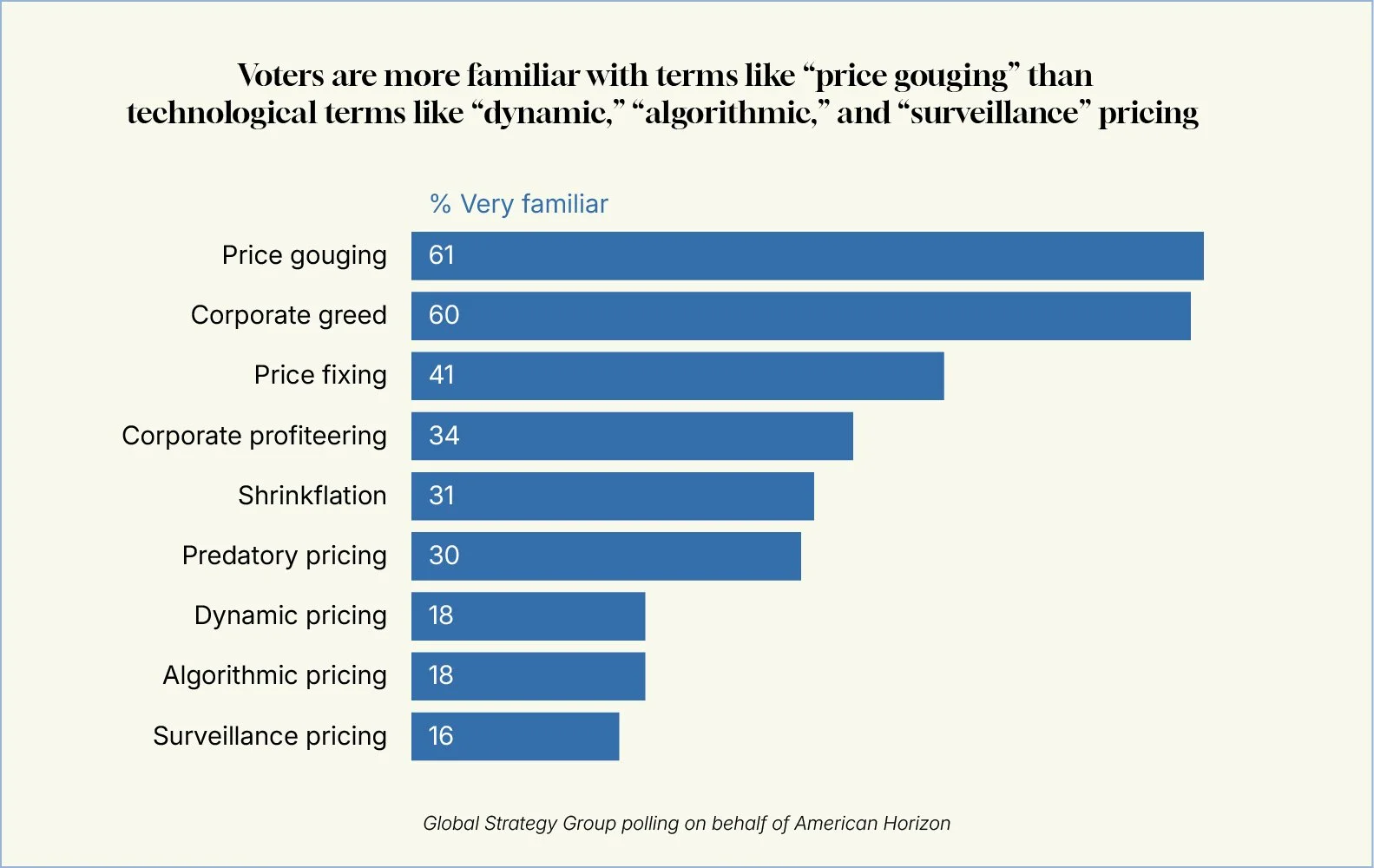
“Price gouging [is] websites that track what you look for and the price changes one computer to the next.”
— Trump voter, woman
“No, have not heard of companies using AI to increase prices but I’m not surprised. Companies are always trying to find ways to make sure they pay less and the consumer pay more.”
— Democratic low-turnout voter, woman
Health insurance costs are a major pain point. There is a clear opening to engage in a debate about limiting health insurers from using AI to deny claims, including for seniors on Medicare.
Voters believe that health insurers raising costs while denying claims is a big problem in their lives. They identify insurers using AI to deny claims as highly concerning, even more so than data centers or job displacement. Concerns about health insurers using AI to deny claims are not limited to partisan camps, generating strong concern across Democrats, Independents, and Republicans (especially Republican women). From a long list of ways companies could misuse AI, voters say health insurance companies using AI to deny payment for patient claims, including for seniors on Medicare (something already happening in several states), is most troubling, and in qualitative research, voters express concern about having a “robot,” rather than a doctor, determine their access to health care. A proactive solution that calls for banning this practice is among the most popular we tested, particularly with seniors.
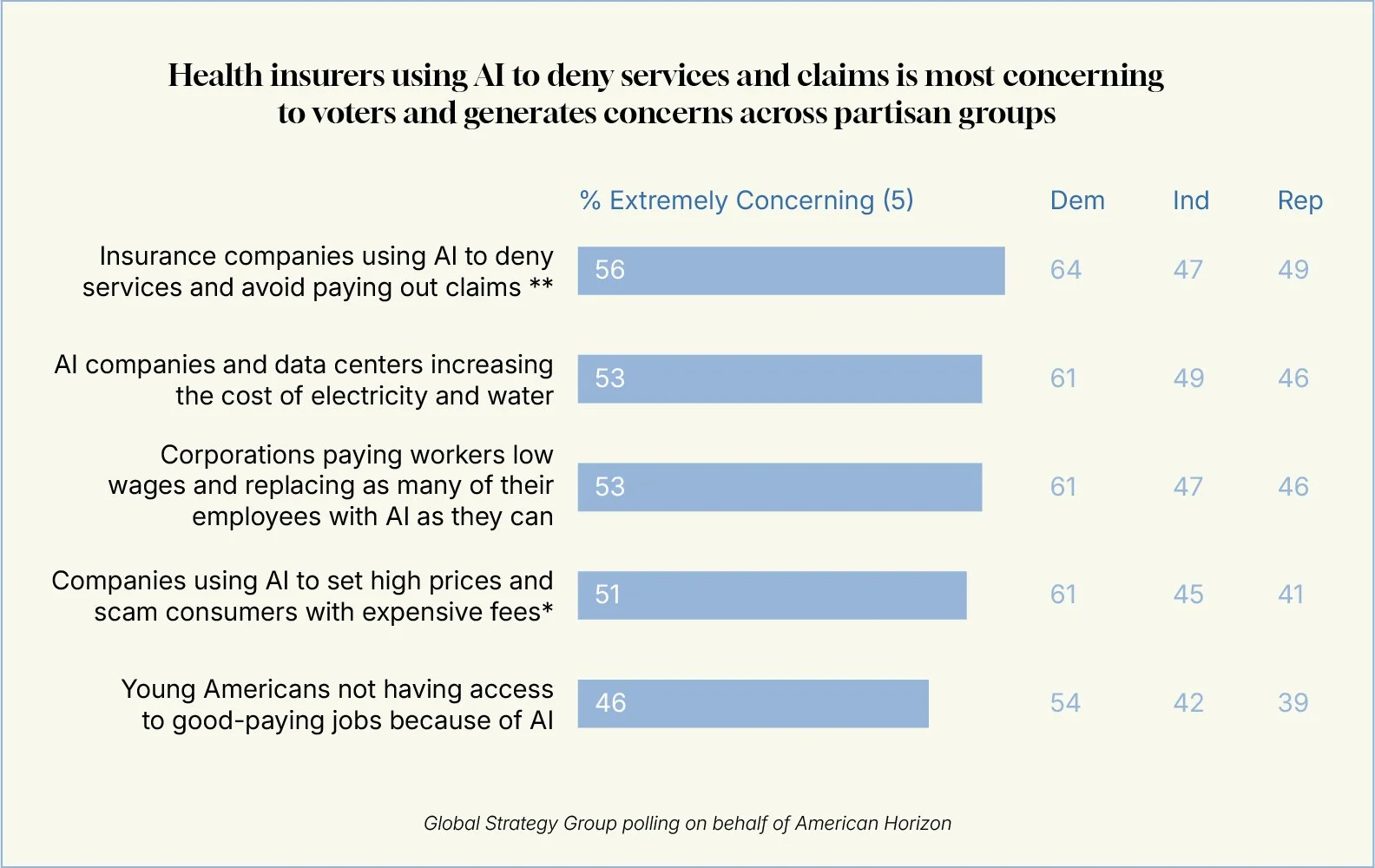
“I definitely worry about being denied claims. Insurance is already expensive so then having to pay for more services on top of that if your claim gets denied.”
— Trump voter, woman
·“Going to go out on a limb here and say that pretty much every decision made by any insurance company is going to be based on a desire to decrease risk, cut costs and increase profits. Actual people always get left behind.”
— Democratic low-turnout voter, man
After health claims, there are three other proactive solutions that resonate with voters and rise to the top among Democrats, Independents, and Republicans:
Stopping corporations from exploiting people’s personal information.
Many find it troubling that companies can use AI to mine information about people’s personal data. Voters respond well to a statement about restricting corporations’ access to private data and allowing people to have their information deleted from the internet.
“Everyone has a right to privacy and any information about health and finances, and online behavior needs to be protected. To me it’s important. It’s part of being an American.”
— Trump voter, woman
Stronger protections against AI-driven price hikes.
While narrow statements about surveillance or dynamic pricing don’t elicit significant concern (in part because most are unfamiliar with these practices), voters respond well to proposals that call for “fair pricing” by stopping companies from “charging different people different prices based on their personal data” and using AI to “set prices high” and collude with competitors.
“What stands out the most to me is that companies can track how much you usually spend on stuff and tailor higher prices to you specifically.”
— Democratic low-turnout voter, woman
Protecting everyday people from scams and fraud.
Voters are troubled by how corporations could use AI to scam consumers, and view AI as a potential tool for fraud. Voters want to know that pricing is transparent and fair. Banning companies from using AI to charge hidden fees stands out as a clear avenue to lower costs.
“Price transparency would be hugely beneficial to ensure people aren’t being scammed and taken advantage of.”
— Democratic low-turnout voter, woman
Proposals calling for a data center moratorium and protections for workers are less effective than those that focus on preventing companies from using AI to increase costs.
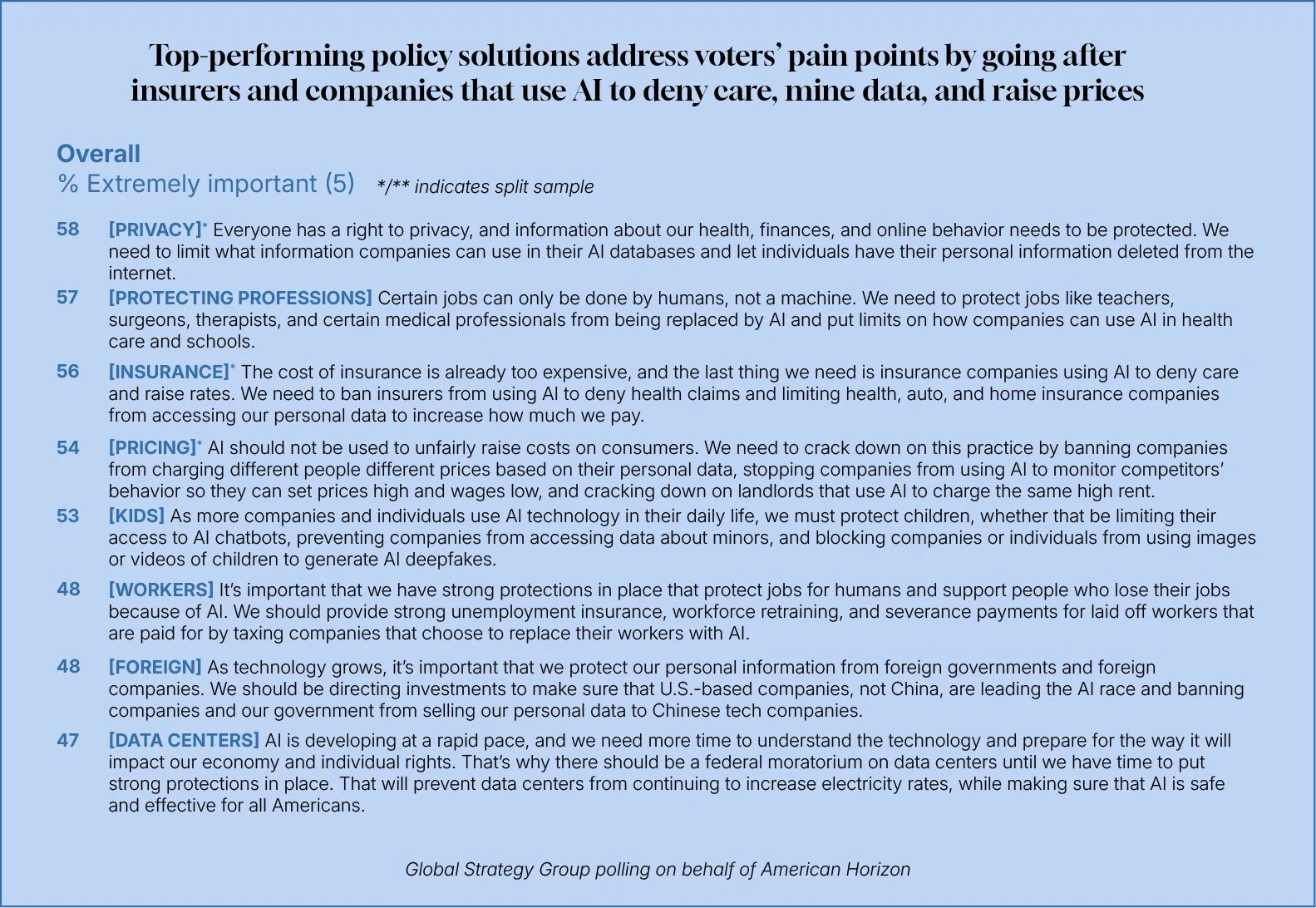
To be successful, we need to…
1. Incorporate corporate practices involving AI into a larger narrative about costs, affordability, and corporate power.
What to say: Speak to voters’ frustrations with constantly rising prices and corporate power. Incorporate concerns about AI misuse into a larger narrative around costs and corporate abuse.
How to say it: Every year, American families pay more and get less, as the costs of things like insurance and health care keep going up. Big corporations are raking in record profits and paying their CEOs millions of dollars a year, while charging more. The last thing we need is more price hikes and we need to stop corporations from using AI to increase costs for everyday people.
2. Identify specific harms, not abstract debates about technology
What to say: Avoid technical terms like surveillance pricing, dynamic pricing, and algorithmic pricing. Keep the focus on corporate bad actors and specific ways they can use the technology to increase costs, rather than presenting AI itself as the problem.
How to say it: We need to crack down on corporate greed and price gouging by stopping companies from using AI to deny payment for health care claims, scam consumers, and mine people’s personal data without their knowledge or consent.
3. Identify the solution:
What to say: Identify concrete solutions that address voters’ key concerns about corporate misuse of AI, including:
Banning health insurance companies from using AI to deny claims and making sure that doctors, not machines, make decisions about health care
Restricting the personal information companies can use in their databases and allowing individuals to have their personal data deleted from the internet
Cracking down on companies that use AI to raise costs by guaranteeing fair pricing and banning companies from charging different people different prices based on their personal data and monitoring their competitors’ behavior so they can collude to set prices high
Stopping companies from using AI to scam and defraud consumers by improving pricing transparency and banning companies from using AI to charge hidden fees
About This Research
Global Strategy Group conducted an online survey of 1,497 2026 likely voters nationwide between May 19–27, 2026. The survey has a confidence interval of +/-3.1%. All interviews were conducted via a web-based panel. Oversamples of an additional 100 interviews among Black voters, 100 interviews among Hispanic voters, and 100 interviews among 18-29 year old voters were conducted for a total of 267 interviews among Black voters, 217 interviews among Hispanic voters, 218 interviews among 18-29 year olds. Care has been taken to ensure the geographic, political, and demographic divisions of the population of likely voters are properly represented. Additionally, the oversamples of Black, Hispanic, and 18–29 year old voters have been weighted to their appropriate proportion of likely voters overall.
Global Strategy Group conducted an online qualitative journal exercise between June 15-17., 2026. The research included 35 swing and motivation targets in the House and Senate battleground. Participants were screened based on their partisan and ideological attitudes, self-reported vote history, and attitudes towards the 2026 election.